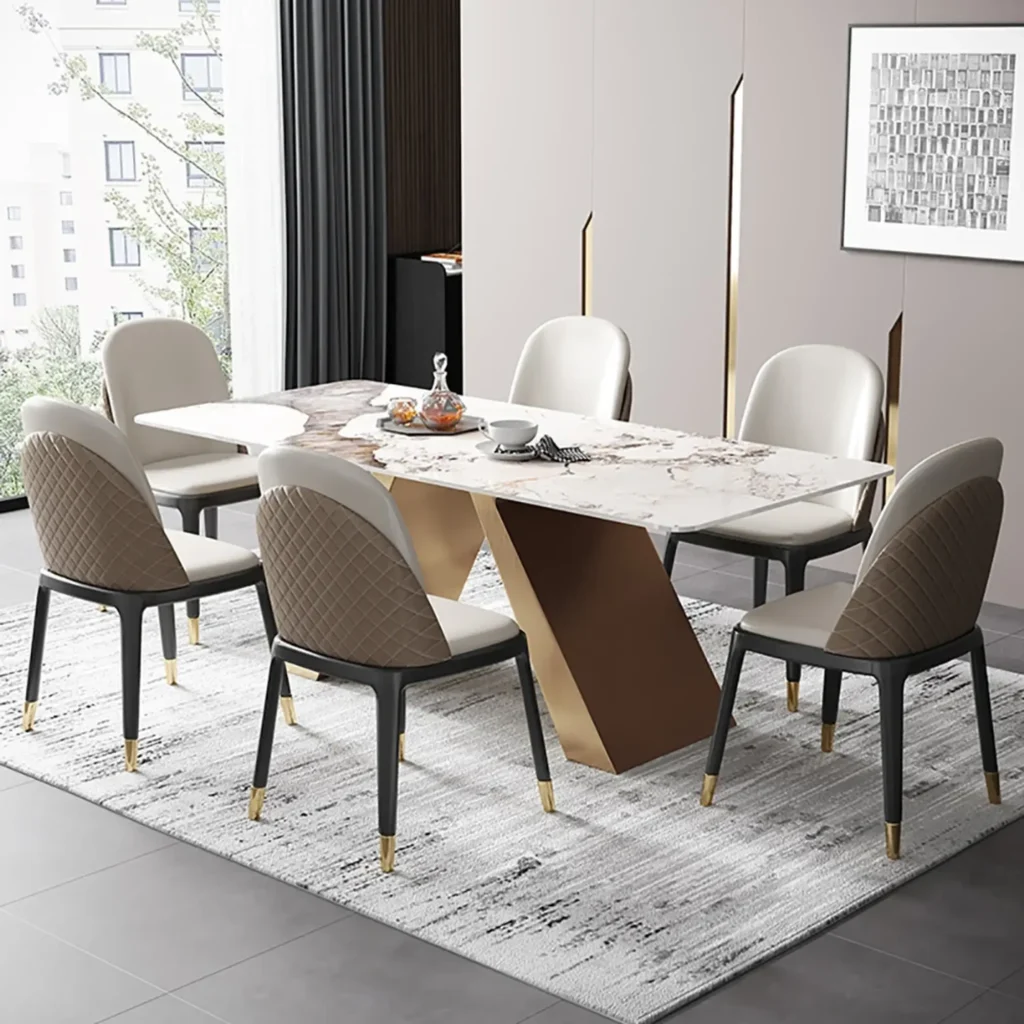
Italian composite marble and natural marble should not be treated as interchangeable product descriptions. Before comparing furniture, establish what the tabletop is made from, how it is constructed and which care instructions apply. A marble-like appearance alone cannot answer those questions.
Start with the written material specification
Natural marble is a natural stone. A product labelled composite marble needs a separate explanation of its composition and construction. Do not infer the binder, stone content, backing or surface treatment from the word composite alone. Ask the seller for a specification for the particular top being supplied.
The word Italian also deserves clarification: ask whether it describes manufacturing origin, raw-material origin, a design style or a supplier’s product name. Request supporting documentation if origin is important to your decision.
A Sajosamaan example

The Sajosamaan luxurious marble-top dining table is explicitly listed with an Italian composite marble top. That wording should not be shortened to solid natural Italian marble. Its metal base and PVD finish are separate specifications from the tabletop.
Compare these details, not just the photographs
- Composition: ask for the exact material description rather than a broad marble label.
- Construction: confirm the top’s thickness, edge build-up and any backing or support.
- Appearance: request photographs of the actual finish or a representative sample, and clarify expected variation.
- Use limits: ask about heat, staining, scratching and approved cleaning methods for that specific top.
- Service: confirm warranty exclusions and what happens if the top arrives damaged.
Care advice must match the surface
The Natural Stone Institute’s care guidance warns that acids can dull or etch calcareous natural stones and that abrasive cleaners can scratch surfaces. This is useful context for natural marble, but it is not a substitute for instructions for an unspecified composite product.
Do not assume that every composite top is stain-proof, heat-proof or maintenance-free. Equally, do not assume that every top needs the same sealer. Get the manufacturer’s approved routine in writing and check it before using a cleaner or treatment.
Which tabletop should you choose?
Choose the product whose documented properties, appearance and care requirements suit your household. Neither label alone establishes better value or durability. Compare the full furniture piece too: dimensions, base stability, delivery access and after-sales terms all affect the purchase.
Alongside the tabletop specification, understand the base’s PVD finish as a separate component. Then use the dining-table pre-order checklist to confirm dimensions, package contents and delivery arrangements before buying.
Browse the Sajosamaan dining-table collection and centre-table collection. Keep a shortlist with each product’s exact material wording so your final comparison is like-for-like.