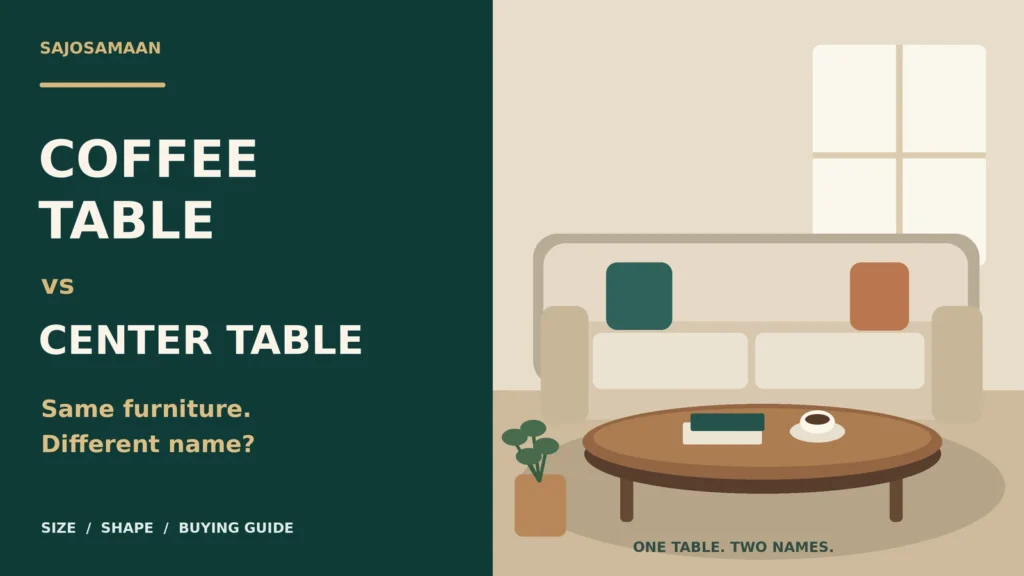
A coffee table and a center table usually refer to the same piece of living-room furniture: a low table placed in front of a sofa or within a seating arrangement. The relationship is straightforward—‘coffee table’ emphasizes everyday use, while ‘center table’ emphasizes its position and role in bringing the seating area together.
In Indian furniture shopping, these names commonly overlap. You do not need to buy two separate tables simply because a catalogue uses both terms. Compare the actual dimensions, construction and features instead.
Coffee table vs center table: quick comparison
| Question | Coffee table | Center table |
|---|---|---|
| What does the name emphasize? | A convenient surface for drinks, books and everyday items | A central surface and visual anchor within the seating area |
| Where is it placed? | Usually in front of the sofa | Usually within the living-room seating arrangement |
| Does the name determine the size? | No—check the product measurements | No—check the product measurements |
| Can it have storage? | Yes, depending on the design | Yes, depending on the design |
| Are the terms interchangeable? | Often yes, especially in Indian living-room furniture listings | |
Why do the two names overlap?
One table can serve several roles at once. It holds a cup of coffee, provides a place for a serving tray, keeps remotes within reach and creates a focal point between seats. A seller may therefore call the same design a coffee table, center table or centre table.
‘Center’ and ‘centre’ are spelling variants, not separate furniture types. Some retailers describe center tables as more formal or decorative and coffee tables as more casual. Treat that as the retailer’s description—not a universal rule that every center table must be larger, taller or more expensive.
Does a center table have to sit in the exact middle of the room?
No. Think about the center of the seating arrangement rather than the geometric center of the entire room. If your sofa sits on one side of an open-plan living room, placing the table in the room’s exact middle could make it awkward to reach.
Position it where seated people can use it comfortably without blocking the route to a doorway, balcony or adjoining space. With an L-shaped sofa, the usable opening between the sofa and chaise matters more than the room’s overall dimensions.
How to choose the right size for either name
Use these proportions as starting points, not fixed rules. Your sofa, room layout and mobility needs should decide the final fit.
- Length: a table around two-thirds of the sofa’s length is a useful initial target.
- Height: aim for approximately the sofa-seat height, or about 2.5–5 cm lower. Measure the seat cushion, not the sofa back.
- Reach: roughly 40–46 cm between the sofa and table is a common starting point for sitting down and reaching items.
- Circulation: keep the main walking route wider than the sofa-to-table gap. Around 76–91 cm can be a planning starting point; allow more wherever users need it.
A simple measurement example
For a 210 cm sofa, two-thirds gives a starting table length of about 140 cm. If the seat is 45 cm high, a table around 40–45 cm high may suit the arrangement. These figures are an illustration, not a recommendation for every room: a smaller table may work better where space is limited.
Mark the proposed tabletop footprint on the floor with masking tape. Sit down, stand up and walk around it. Check that drawers can open and a lift-top, if included, will not collide with the sofa or nearby furniture.
Which shape works best?
- Rectangular: consider it beside a long straight sofa when the layout leaves enough circulation space.
- Round: consider it for a compact seating group or where projecting corners would interrupt movement. Check the base as well as the top.
- Oval: consider it when you want a longer surface with curved ends.
- Square: consider it within a broad seating arrangement, but verify that all seats can reach it.
- Nesting tables: consider them when you want separate movable surfaces. Check the footprint when both tables are in use, not only when nested.
Rounded corners are a useful consideration in a busy family room, but shape alone does not make furniture child-safe. Stability, construction and how the table is used also matter.
Choose by daily use, not by the label
For tea, snacks and guests
Look for a stable surface with enough usable room for your serving tray. Ask about the finish and its care instructions rather than assuming every wood, stone or glass surface handles spills and heat equally well.
For a clutter-prone living room
Compare drawer space, shelves and access from the sofa. An open shelf may suit frequently used books; a drawer can hide small items. Check that handles and open drawers will not obstruct movement.
For occasional laptop use
A lift-top design may bring the surface closer, but verify the raised height, mechanism, stability and manufacturer’s load guidance. A conventional low coffee table should not automatically be treated as a comfortable desk for long work sessions.
For easier maintenance
Ask what the tabletop and base are actually made from. ‘Marble-look’ does not necessarily mean natural marble, and ‘wood finish’ does not necessarily mean solid wood. Follow the care guidance for the specific product, use coasters where appropriate and check whether the surface needs special cleaning or sealing.
Buying checklist: coffee table or center table
- Measure your sofa length, seat height and available floor space.
- Check the table’s full length, width and height, including any projecting base.
- Confirm the material, finish and construction instead of relying on the product name.
- Test the planned footprint and keep important walking routes clear.
- Check storage access, assembly requirements and delivery access.
- Review the seller’s actual warranty, return policy and care instructions before ordering.
For visual inspiration after measuring your space, explore our modern center table designs. You can also review our sofa set design guide to plan the seating arrangement around your table.
Frequently asked questions
Is a coffee table the same as a center table?
In many Indian living-room furniture listings, yes. Both names commonly describe the low table in front of the sofa. The individual product specifications are more useful than the naming difference.
Is a center table always bigger than a coffee table?
No. A retailer may use that distinction for its own collection, but the label alone does not establish size. Compare the listed dimensions.
Can a coffee table be used as a center table?
Yes, if it suits the scale, seating and daily use of your room. The same piece can provide both a practical surface and a visual focal point.
Are center table and centre table different?
No. The spelling changes; the furniture category does not.
Is a side table the same thing?
A side table usually sits beside a sofa or chair rather than in front of the seating group. It can complement a coffee table, or provide a nearby surface where a central table would crowd the layout.
The takeaway
The relationship between coffee table and center table is primarily about naming and emphasis, not a strict difference in furniture design. Start with your seating layout and everyday needs, then choose the dimensions, shape, material and features that fit. A well-chosen table should be easy to reach, leave room to move and work for the way you actually use your living room.
Further reading
- Royaloak: coffee and center table terminology
- Pepperfry: centre table terminology and shopping considerations
- Furniture From The Barn: coffee table sizing and spacing guide